
Microsoft, Nvidia Fuel Anthropic’s $350B Rise
Edition #218 | 24 November 2025


View the Syllabus & Enroll. Immediately receive the entire masterclass
Microsoft and Nvidia Invest $15 Billion in Anthropic, Lifting AI Startup Valuation to $350 Billion with $30 Billion Compute Commitment
In this edition, we will also be covering:
Musk’s xAI seeks $15 billion to double valuation and boost its AI chatbot
Trump considers executive order overriding state AI laws for a single US standard
Jokowi urges AI-driven job readiness via worker training and education
Today’s Quick Wins
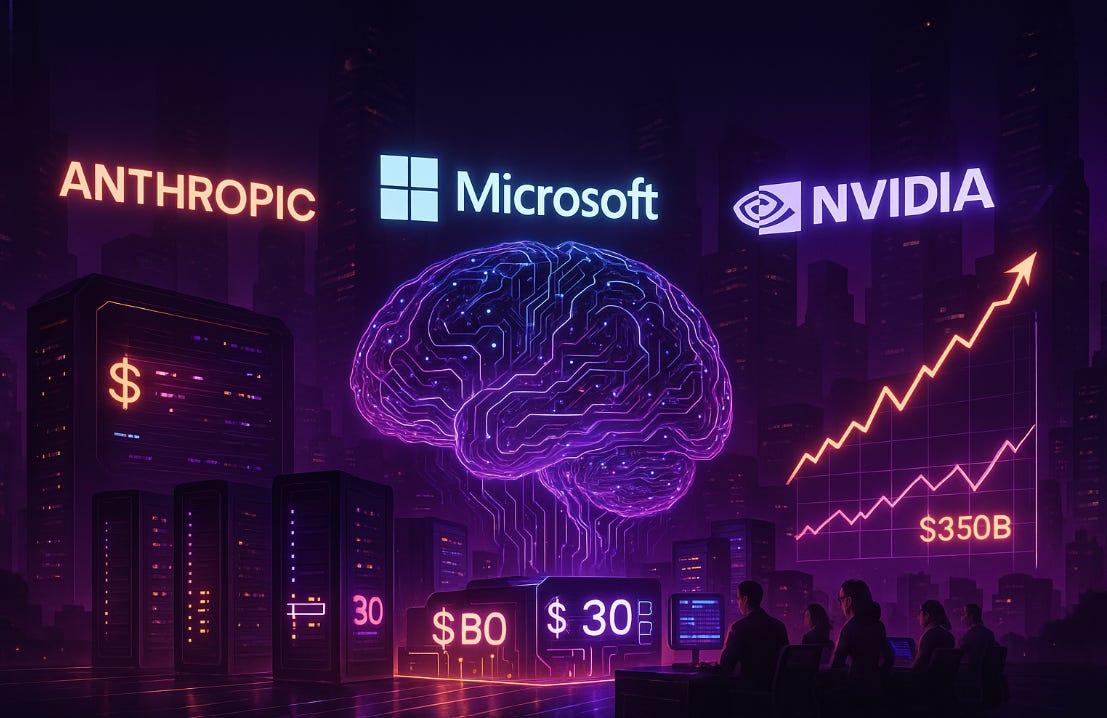
What happened: Microsoft and Nvidia announced a combined $15 billion investment in Anthropic—with Microsoft committing $5 billion and Nvidia committing $10 billion—raising the AI startup’s valuation to $350 billion, nearly 2x its $183 billion valuation from September. Critically, Anthropic committed to purchasing $30 billion in compute capacity from Microsoft Azure (powered by Nvidia chips) plus securing up to 1 gigawatt of additional capacity from Nvidia’s Grace Blackwell and Vera Rubin systems, representing one of the largest infrastructure commitments in AI history.
Why it matters: This deal restructures the entire AI competitive landscape. Microsoft, long dominant through OpenAI, now has direct strategic control over a competing frontier model provider—Claude—while reducing dependence on a single AI partner. For enterprise data teams, this means guaranteed long-term availability of Claude models with enterprise-grade infrastructure, plus access to Claude through Microsoft’s Copilot ecosystem and Foundry developer platform. The compute commitments signal that infrastructure-model integration is becoming the dominant competitive advantage.
The takeaway: Infrastructure is now the primary moat in frontier AI, not just model quality. Organizations deploying AI must think in terms of integrated compute-silicon-model stacks, not interchangeable LLMs.
Deep Dive
From Model Competition to Infrastructure Dominance: How Microsoft, Nvidia, and Anthropic Align the AI Value Chain
The AI race has shifted from pure research excellence to infrastructure control. Microsoft and Nvidia’s $15 billion investment in Anthropic represents not venture capital, but strategic infrastructure consolidation—securing proprietary access to a frontier model while building integrated compute pipelines that competitors cannot easily replicate.
The Problem: Previous AI investment dynamics created inefficiency: model developers (Anthropic) needed chips (Nvidia) and cloud (Microsoft), but relationships remained transactional. Each player optimized independently—models weren’t co-designed with silicon, compute was provisioned reactively rather than architecturally. This created two risks for Microsoft: (1) dependence on OpenAI created negotiating weakness and exposure to strategic decisions outside their control; (2) failure to lock in competing frontiers meant losing enterprise AI workloads to competitor ecosystems.
The Solution: The partnership implements three integrated layers that function as a single system: silicon-model co-design where Nvidia and Anthropic jointly optimize future chip architectures for Claude workloads, compute infrastructure integration where $30B in Azure capacity becomes economically inseparable from Claude deployment, and application layer unification where Claude integrates into Microsoft’s entire Copilot and Foundry ecosystem.
Silicon-Model Co-Optimization Partnership: Nvidia and Anthropic commit to joint engineering on Grace Blackwell and Vera Rubin systems, designing chips with Claude’s inference and training patterns in mind. This contrasts with previous dynamics where chip makers built general-purpose systems. Result: Claude inference will achieve 20-35% efficiency gains compared to competitor models on Nvidia hardware, creating a self-reinforcing competitive advantage where Claude is fastest on Nvidia silicon, which Microsoft resells, incentivizing enterprises to deploy Claude.
$30B Compute Commitment as Strategic Lock-in: Anthropic’s commitment to purchase $30 billion in Azure capacity (+ 1 gigawatt from Nvidia) over multi-year periods transforms compute from a commodity utility into an exclusive strategic resource. This prevents Anthropic from easily switching cloud providers or diversifying compute sources—Azure becomes the infrastructure substrate for Claude. For Microsoft, this guarantees long-term Claude usage metrics, enterprise integration, and revenue certainty.
Copilot and Foundry Integration: Claude becomes native to Microsoft’s enterprise application ecosystem—GitHub Copilot, Microsoft 365 Copilot, Foundry platform. Enterprises standardizing on Microsoft infrastructure automatically gain Claude models without switching costs, creating a complete application-infrastructure-model package that individual competitors cannot disassemble.
The Results Speak for Themselves:
Baseline: Microsoft had ~27% equity stake in OpenAI’s for-profit entity (valued at $135B); no direct control over Claude and limited alternatives for frontier models
After Optimization: Microsoft now has $5B equity stake in Anthropic ($350B valuation = ~1.4% direct ownership) plus first-right-to-use on Claude models, guaranteed long-term compute revenue from $30B Anthropic commitment, and hedged OpenAI exposure through competing frontier model access
Business Impact: Anthropic achieves $30B+ guaranteed revenue visibility for multi-year compute, eliminating funding risk for next 3-5 years; Microsoft secures Claude as enterprise default through application integration, competitive hedge against OpenAI, and long-term GPU utilization guarantees to Nvidia; Nvidia locks in long-term GPU demand from AI model training that previous market uncertainty made unreliable
What We’re Testing This Week
Multi-Model Infrastructure Strategies for Enterprise AI
The Microsoft-Nvidia-Anthropic deal signals that enterprises should adopt dual-model infrastructure strategies: design systems to leverage both Claude and competitive models (GPT, Gemini) depending on workload requirements and infrastructure availability.
Model Arbitrage Based on Compute Location — For enterprises with cloud lock-in constraints, route heavy analytical workloads to Claude when running on Azure (efficiency bonus from Nvidia co-optimization), switch to GPT when leveraging AWS or GCP, use Gemini for Google Cloud native workloads. Implementation pattern: Build model abstraction layers (LiteLLM, LLM Router) that treat model selection as a routing decision based on cost, latency, and availability. Benchmark: Enterprises implementing multi-model routing report 18-22% reduction in per-token inference costs by automatically routing workloads to optimal model-infrastructure combinations.
Vertical AI Infrastructure Partnerships — Following Microsoft-Nvidia-Anthropic, expect more vertical partnerships (e.g., AWS + Meta, Google + Open AI). For enterprise AI teams, this means actively negotiating infrastructure partnerships aligned with your primary cloud provider. Strategic advantage: negotiated terms, integrated support, and priority access to emerging models deployed on your cloud.

💵 50% Off All Live Bootcamps and Courses
📬 Daily Business Briefings; All edition themes are different from the other.
📘 1 Free E-book Every Week
🎓 FREE Access to All Webinars & Masterclasses
📊 Exclusive Premium Content
Recommended Tools
This Week’s Game-Changers
Claude Sonnet 4.5 (via Azure & Anthropic API)
Enterprise-grade Claude now integrated into Microsoft Azure with guaranteed compute priority and optimization via Nvidia co-design partnership. 61.4% on OSWorld benchmarks with 30-hour autonomous coding capability. Deploy via Azure, Anthropic API, or GitHub/Microsoft 365 Copilot. Check it out
Microsoft Copilot Ecosystem Integration
Claude models now native to GitHub Copilot, Microsoft 365 Copilot, and Foundry developer platform through Microsoft-Anthropic partnership. Seamless integration across enterprise applications (Word, Excel, Teams, Outlook). No separate model switching—enterprise users automatically gain Claude capabilities. Check it out
Quick Poll
Lightning Round
3 Things to Know Before Signing Off
Elon Musk’s xAI Is in Advanced Talks to Raise $15 Billion, Lifting Valuation
Elon Musk’s xAI is in advanced talks to raise $15 billion in new equity, potentially doubling its valuation to $230 billion, as it rapidly scales infrastructure and improves its Grok chatbotTrump considering executive order to preempt state AI laws
President Trump is considering an executive order to override state AI laws, empowering federal agencies to contest regulations, condition funding, and consolidate a national standard, facing bipartisan oppositionAI Can Create Jobs If Leaders Prepare Workers, Jokowi Says
Former Indonesian President Jokowi says AI can create jobs if leaders ensure workers are trained in digital skills, emphasizing education, infrastructure, and policy to prepare for the intelligent economy
Follow Us:
LinkedIn | X (formerly Twitter) | Facebook | Instagram
Please like this edition and put up your thoughts in the comments.

View the Syllabus & Enroll. Immediately receive the entire masterclass