

MASTER AI IN 16 HOURS AND BECOME IRREPLACEABLE BEFORE 2025 ENDS!
Join Outskill’s 2-Day AI Mastermind, a hands-on training to make you an AI-powered pro who can learn, earn, and build with AI.
This Sat & Sun 🕜10 AM to 7PM (EST)
Usually $395, but as a part of their halloween sale 🎃, you can get in for completely FREE!

In 16 hours, you will:
✅ Build AI agents that save up to 20+ hours weekly
✅ Master 10+ AI tools
✅ Automate 80% of your workload, And Much more.
🎁 Unlock $5000+ in AI bonuses - all free when you attend!
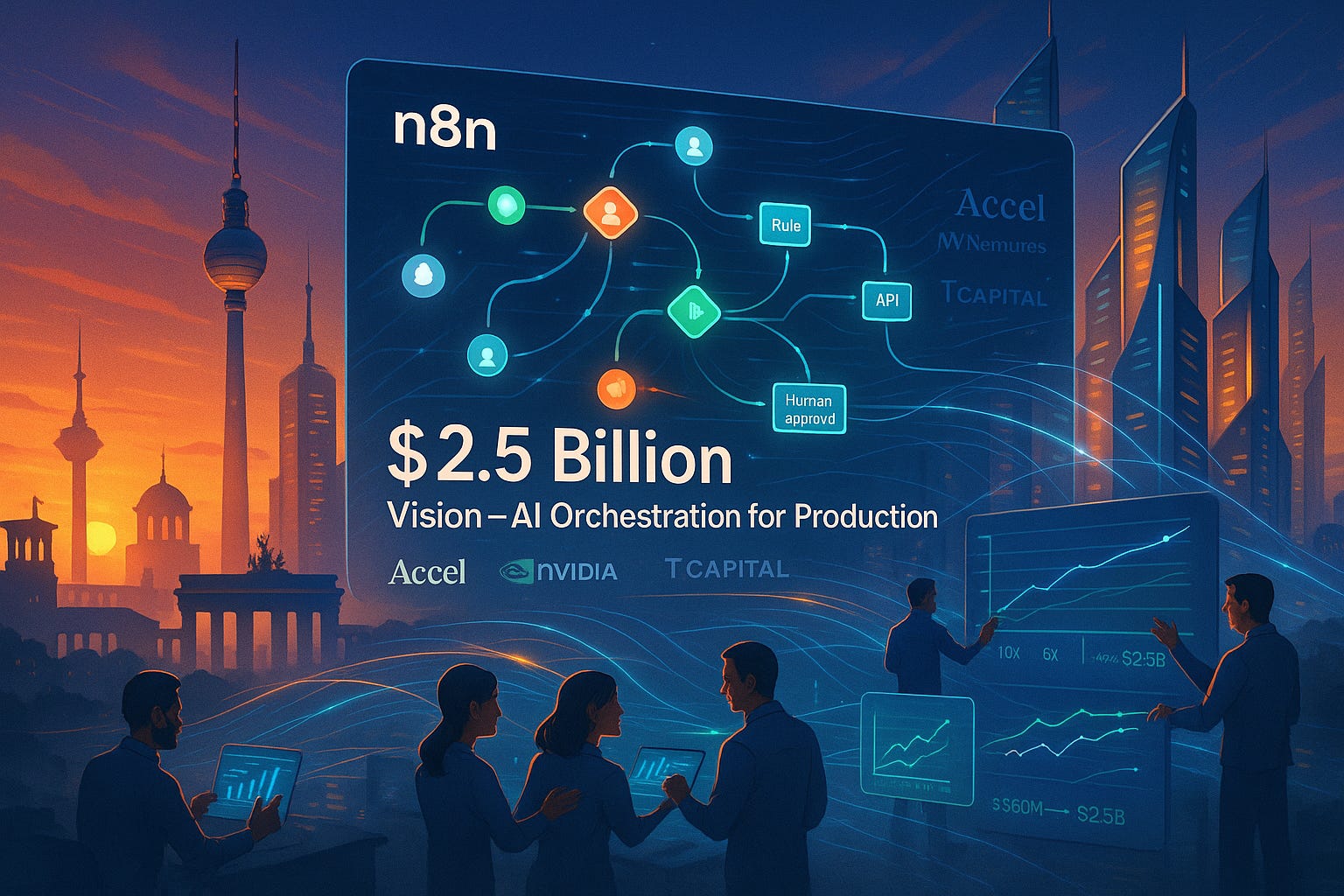
n8n Raises $180M at $2.5B Valuation with Workflow Orchestration Platform Scaling 10x Revenue
In this edition, we will also be covering:
Ant Group AI Powerhouse Ling-1T
OpenAI’s $25B AI Data Center Bet in Argentina
Anthropic Taps India’s AI Talent
Today’s Quick Wins
What happened: German AI workflow orchestration startup n8n closed $180 million in Series C funding led by Accel, reaching a $2.5 billion valuation. The Berlin-based company, which provides a flexible platform for deploying AI agents with human oversight, grew revenue 10x and users 6x year-over-year as enterprises demand greater control over autonomous AI systems. NVIDIA’s venture arm NVentures participated alongside T.Capital, with total funding now at $240 million.
Why it matters: The massive valuation jump (from $350 million just months ago) signals investor conviction that AI orchestration, not just model capabilities, will determine which companies successfully deploy AI in production. n8n’s hybrid approach, allowing teams to balance AI autonomy with rule-based control, directly addresses the deployment gap where powerful models fail in business-critical workflows due to unpredictability.
The takeaway: Pure autonomous AI agents struggle in production because businesses can’t afford unpredictability in critical workflows. The winning pattern combines AI decision-making with structured orchestration, human oversight, and cross-functional collaboration on a single platform. If you’re building AI systems, invest as much time in orchestration infrastructure as in model selection.
Deep Dive
Why n8n’s $2.5B Valuation Signals the End of Pure Autonomous AI
The AI industry has been selling a dream: autonomous agents that handle complex business processes with minimal human intervention. Just write a prompt, and watch the AI work its magic. n8n’s explosive growth and Series C valuation tell a different story, one that’s playing out across enterprises worldwide.
After years of building AI systems, organizations are discovering that pure autonomy creates spectacular demos but unreliable production systems. Meanwhile, rigid rule-based automation requires developer involvement for every change. n8n’s rapid ascent to unicorn status (7x valuation increase in under a year) proves that the market is desperate for something in between.
The Problem: Enterprises face a painful choice with AI agents. Full autonomy delivers impressive results when it works, but a single hallucination or misinterpreted context can corrupt databases, send incorrect information to customers, or make flawed business decisions. On the flip side, traditional workflow automation with tools like Zapier offers reliability but demands developers to hard-code every decision path, making iteration slow and collaboration across technical and business teams nearly impossible.
The Solution: n8n built a workflow orchestration platform that treats AI as one component in a larger system, not the entire solution. Their architecture enables what they call “flexible control” across the autonomy spectrum. Here’s the technical breakdown:
Hybrid Decision Routing: n8n’s workflow canvas lets teams configure exactly where AI makes autonomous decisions versus where logic follows predetermined rules. You might use GPT-4 to interpret customer intent but route the actual actions through validated API calls with error handling. The platform includes node-based workflow design where each node can be AI-powered (LLM calls, vector searches), code-based (custom Python/JavaScript), or application-integrated (database queries, API calls). This granular control means you get AI’s flexibility without surrendering reliability.
Cross-Functional Orchestration Layer: The platform provides a visual workflow editor where domain experts can configure business logic without writing code, while developers handle complex integrations and custom nodes. This coordination happens in real-time on the same canvas. For data teams, this means business analysts can modify decision criteria in a customer churn prevention workflow while you manage the underlying ML model endpoints and feature engineering pipelines, no ticket handoffs or multi-week iteration cycles.
Production Monitoring with Human-in-the-Loop: n8n includes built-in evaluation tools that track AI decision quality, allowing teams to add human approval gates for high-stakes decisions while letting routine tasks run autonomously. You set confidence thresholds: predictions above 95% confidence execute automatically, while anything in the 70-95% range queues for human review. The system learns which decisions require oversight based on real-world outcomes, dynamically adjusting autonomy levels.
The Results Speak for Themselves:
Baseline: $350 million valuation in April 2025 with traditional workflow automation focus
After AI Pivot: $2.5 billion valuation (614% increase) after positioning as AI orchestration platform for production deployments
Business Impact: 10x revenue growth and 6x user expansion year-over-year, with customers ranging from solo developers to the United Nations running mission-critical workflows processing millions of transactions
What We’re Testing This Week
Prompt Caching Strategies: Maximizing API Cost Savings
With Claude and GPT-4 now offering prompt caching, we’re testing optimal strategies for applications with large system prompts or document contexts. Early results show 85-90% cost reduction is achievable with the right architecture.
Static Context Front-Loading: Our tests with Claude’s prompt caching show that placing your system prompt and static context at the beginning of your messages (before any variable user input) achieves cache hit rates above 95% in conversational applications. For a 50,000 token system prompt (documentation, examples, guidelines), this reduces per-request costs from $0.75 to $0.08, a 90% savings. Implementation pattern: Structure your prompt with system instructions first, then static examples, then dynamic user content. Cache TTL is 5 minutes, so applications with sustained usage see near-constant cache hits.
Dynamic Context Chunking: For RAG applications where retrieved context changes with each query, we’re seeing 60-70% cost reduction by separating retrieval into “hot” and “cold” documents. Frequently accessed documents (user’s previous conversations, common reference material) go in a cached prefix, while query-specific retrieved chunks go in the variable suffix. Smart chunking strategy: Keep your top 10 most-accessed documents in the cached region, refresh every 50 queries. Latency drops from 4 seconds to under 600ms for cached hits.
💵 50% Off All Live Bootcamps and Courses
📬 Daily Business Briefings; All edition themes are different from the other.
📘 1 Free E-book Every Week
🎓 FREE Access to All Webinars & Masterclasses
📊 Exclusive Premium Content
Recommended Tools
This Week’s Game-Changers
n8n Workflow Automation
Open-source platform for AI orchestration with 400+ integrations. Self-host or use cloud deployment with visual workflow editor that supports Python, JavaScript, and LLM nodes. Check it outEvaluations by n8n
Built-in framework for testing AI agent reliability with automated test suites that track decision quality across workflow versions. Includes A/B testing for comparing autonomous vs. rule-based routing. Check it outData Tables in n8n
Native structured data storage within workflows for maintaining state, lookup tables, and intermediate results without external databases. Supports SQL queries and bulk operations. Check it out
Quick Poll
Lightning Round
3 Things to Know Before Signing Off
Ant Group releases powerful AI model to rival DeepSeek and OpenAI
Ant Group released a trillion-parameter AI model, Ling-1T, outperforming DeepSeek and OpenAI in coding, mathematics, and reasoning tasks, intensifying competition in advanced AI and LLM developmentOpenAI and Sur Energy Eye $25 Billion Argentina AI Data Center
OpenAI and Sur Energy are considering a $25 billion investment to build a massive AI data center in Argentina, with the project expected to advance regional AI infrastructure and energy developmentAnthropic Opening Its First India Office to Tap AI Talent
Anthropic is opening its first office in India to access local AI talent, underscoring the country’s growing importance in the global artificial intelligence talent pool and innovation ecosystem
Follow Us:
LinkedIn | X (formerly Twitter) | Facebook | Instagram
Please like this edition and put up your thoughts in the comments.
EXCLUSIVE LIMITED-TIME OFFER: 50% OFF Newsletter Sponsorships!
Get 50% off on all the prices mentioned below
Actual Sponsorship Prices

Vibe Coding Certification - Live Online
Weekends Sessions | Ideal for Non Coders | Learn to code using AI
Love this. n8n’s $2.5B leap proves the winning edge in AI isn’t smarter models but rather it’s smarter systems around them.
At Margin & Moat, we’ve been breaking down how orchestration and governance are the hidden levers of durable value.