
Multimodal AI: When Your Chatbot Can See Hear and Understand Everything
Edition #228 | 17 December 2025


Free Live Masterclass to be held on Next MONDAY by Business Analytics Review
Hello!
Welcome to today’s edition of Business Analytics Review!
Imagine this: You’re in a bustling virtual meeting, sharing your screen with a complex chart while chatting casually about last quarter’s sales dip. Suddenly, your AI assistant not only transcribes the conversation but also spots a trend in the graph you missed, suggests a voice note for your team, and even generates a quick audio summary tailored to a colleague who’s joining late via phone. Sounds like science fiction? Not anymore. Welcome to the world of multimodal AI, where chatbots aren’t just talking heads they’re seeing, hearing, and piecing it all together in real time.
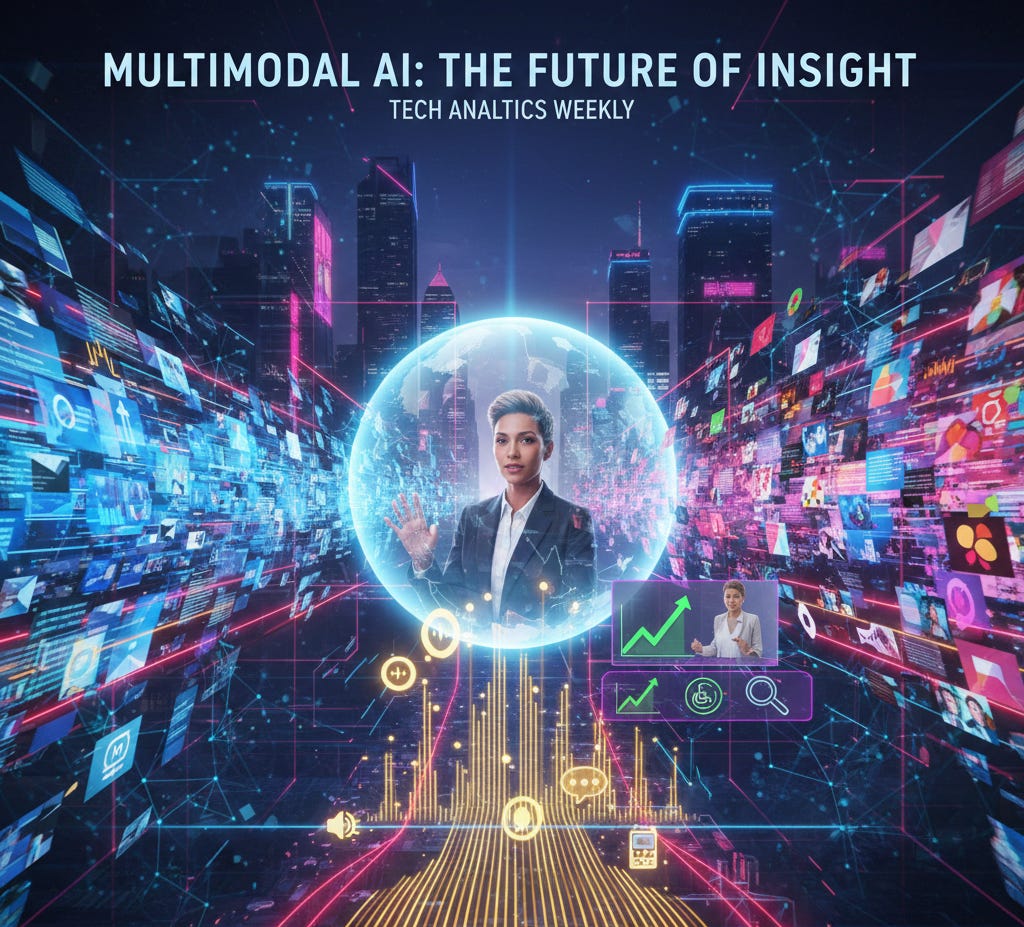
In today’s edition, we’re diving into how powerhouses like OpenAI’s GPT-4o and Google’s Gemini 2.0 are blurring the lines between text, images, and audio. These models aren’t processing one input at a time; they’re fusing them seamlessly, much like how our brains connect a glance at a coffee stain with the story of your clumsy morning spill. This isn’t just tech wizardry it’s a game-changer for businesses, from enhancing customer service to supercharging data analysis. Let’s unpack it step by step, with a dash of real-world magic to keep things grounded.
The Magic Behind the Multimodality
At its core, multimodal AI treats different data types as equals. Traditional models might handle text via tokenization breaking words into numerical chunks for neural networks to chew on but throw in an image or audio clip, and things get tricky. GPT-4o, for instance, uses a unified architecture where vision encoders (think convolutional layers spotting edges in photos) and audio processors (waveform transformers capturing pitch and tone) feed into a shared language model. The result? Real-time responses that feel eerily human.
Take GPT-4o: During its demo, it translated spoken Italian into English subtitles while reacting to facial expressions in a video call all under 300 milliseconds. That’s faster than a blink, making it ideal for live customer interactions where delays kill the vibe. On the industry side, companies like Zoom are already integrating similar tech to auto-generate meeting recaps that include visual highlights from shared slides alongside transcribed discussions.
Then there’s Gemini 2.0, Google’s latest leap, with its Multimodal Live API. Built for the “agentic era,” it streams audio, video, and text simultaneously, enabling apps that adapt on the fly. Picture a retail app where you snap a photo of a wonky shelf, describe the issue verbally, and get instant inventory suggestions pulled from text logs, image recognition, and even ambient store sounds for crowd levels. Technically, it leverages efficient fusion layers to align modalities without ballooning compute costs, which is crucial as businesses scale these tools without breaking the bank.
But here’s a relatable nugget: I once chatted with a marketing exec who used GPT-4o to analyze ad campaign feedback. She uploaded campaign images, customer voice reviews, and email threads. In seconds, it flagged that a color scheme resonated better in audio-described contexts for visually impaired users boosting accessibility scores by 25%. It’s moments like these that remind us: Multimodal AI isn’t replacing jobs; it’s amplifying the human touch in analytics.
Why This Matters for Your Business
In analytics, where data comes in every flavor spreadsheets, dashboards, voice memos this tech turns silos into symphonies. Expect 40% of generative AI solutions to go multimodal by 2027, per Gartner, driving efficiencies in sectors like healthcare (combining scans with patient narratives) and finance (auditing reports via voice and charts). The catch? Ethical fusion ensuring biases don’t creep in across modalities. But with transparent training data, as seen in Gemini’s updates, we’re heading toward fairer, sharper insights.
Of course, it’s early days. Latency in edge devices remains a hurdle, but innovations like distilled models are closing the gap. For now, it’s about experimenting: Start small, like integrating voice queries into your BI tools, and watch productivity soar.

50% Off All Live Bootcamps and Courses
Daily Business Briefings; All edition themes are different from the other.
1 Free E-book Every Week
FREE Access to All Webinars & Masterclasses
Exclusive Premium Content
Recommended Reads
Hello GPT-4o by OpenAI
Unpack the technical debut of GPT-4o and its real-time multimodal prowess straight from the source. Check it outIntroducing Gemini 2.0: Our New AI Model for the Agentic Era by Google DeepMind
Get the inside scoop on Gemini 2.0’s live API and how it’s redefining interactive AI apps. Check it outGPT-4o vs. Gemini: How AI is Changing Human-Computer Interaction
A head-to-head on how these models blend senses to transform everyday interfaces. Check it out
Trending in AI and Data Science
Let’s catch up on some of the latest happenings in the world of AI and Data Science
Oracle-OpenAI Data Centers Delay
Oracle’s data centers for OpenAI, originally set for 2027, face delays to 2028 due to power and construction challenges in AI expansion.China Chip Incentives Plan
China plans up to $70 billion in incentives for its chip sector to boost semiconductor self-reliance amid global AI and tech tensions.SoftBank Data Center Shift
SoftBank considers switching data center groups as CEO Masayoshi Son pursues aggressive AI investment opportunities worldwide.
Trending AI Tool: Hugging Face Transformers

This open-source library is buzzing in 2025 for its ready-to-use pipelines that let developers mix text, images, and audio effortlessly perfect for prototyping multimodal analytics without starting from scratch.
Learn more
Follow Us:
LinkedIn | X (formerly Twitter) | Facebook | Instagram
Please like this edition and put up your thoughts in the comments.

Free Live Masterclass to be held on Next MONDAY by Business Analytics Review