
Multi-Agent Systems: When AI Teams Work Better Than Humans
Edition #240 | 14 January 2025

A very Happy New Year !! We are enrolling 3 students at 1199 USD.
If interested, send your request at vipul@businessanalyticsinstitute.com
Hello!
Welcome to today’s edition of Business Analytics Review!
Your daily dose of insights into the fascinating world of Artificial Intelligence and Machine Learning. I’m thrilled to dive into a topic that’s buzzing in the tech community: Multi-Agent Systems. Imagine a team of AI agents collaborating seamlessly, outperforming what a single human or even a lone AI could achieve. It’s like watching a well-oiled orchestra where each musician plays their part to create something extraordinary. Today, we’ll explore Google DeepMind’s innovative approaches inspired by concepts like the Society of Mind 2.0, drawing from modern frameworks that echo Marvin Minsky’s classic ideas. Let’s break it down step by step, shall we?
Understanding Multi-Agent Systems
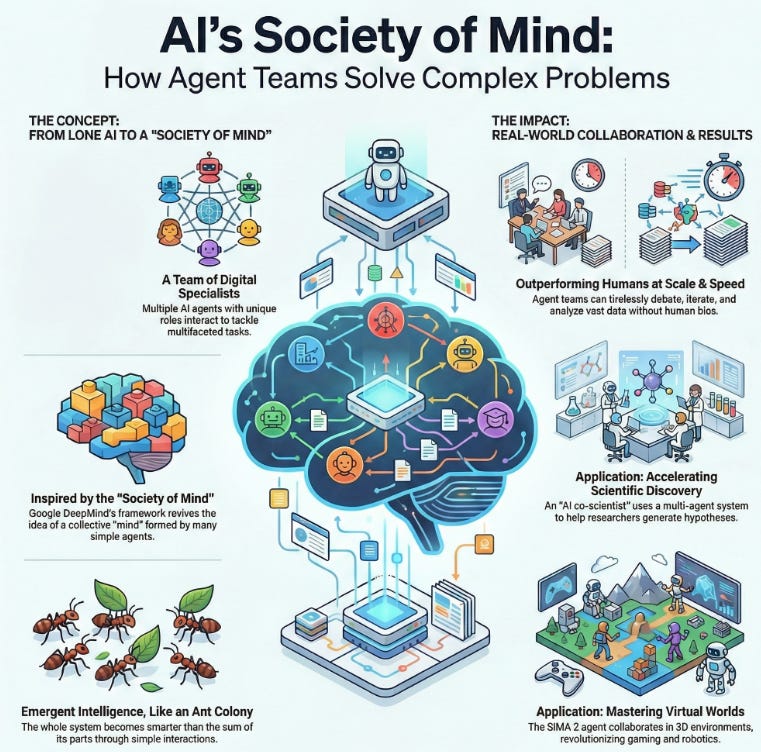
Picture this: in a busy office, a group of specialists tackles a complex project one handles data analysis, another focuses on strategy, and a third refines the output. That’s the essence of multi-agent systems in AI. These are setups where multiple AI agents, each with specialized roles, interact, communicate, and collaborate to solve problems. Unlike traditional single-agent AI, which might struggle with multifaceted tasks, multi-agent systems shine in dynamic environments, adapting in real-time much like human teams.
A fun anecdote: Think about how ants build colonies. No single ant knows the blueprint, but through simple interactions, they create intricate structures. AI multi-agent systems borrow from this emergent intelligence, where the whole becomes greater than the sum of its parts. In business analytics, this means faster insights, like predicting market trends by having one agent crunch numbers while another simulates scenarios.
Google DeepMind’s Take on Society of Mind 2.0
Google DeepMind has been pushing boundaries with frameworks that revive and modernize Marvin Minsky’s “Society of Mind” concept from the 1980s. Minsky envisioned the human mind as a society of simple agents working together, and DeepMind’s Society of Mind 2.0 agent framework updates this for the AI era. It’s about distributed intelligence, where networks of AI agents form a collective “mind” capable of achieving artificial general intelligence (AGI) not through one super-smart entity, but via collaboration. This approach is evident in their recent works, like multi-agent systems powered by Gemini 2.0, designed for the “agentic era” where AI acts more autonomously and collaboratively.
For instance, DeepMind’s AI co-scientist uses a multi-agent setup with Gemini 2.0 to assist researchers in generating hypotheses and proposals, blending technical prowess with practical industry applications in scientific discovery. It’s not just theory; these systems are being applied in areas like code security with tools like CodeMender, where specialized agents handle different aspects of vulnerability detection.
When AI Teams Outperform Humans
Here’s where it gets exciting: Multi-agent systems often work better than humans in scenarios requiring scale, speed, and unbiased decision-making. Humans get tired, have biases, or miss details in vast datasets, but AI agents can tirelessly debate, refine, and iterate. Take DeepMind’s SIMA 2, a generalist embodied agent for 3D virtual worlds it learns and reasons in complex environments, potentially revolutionizing gaming, simulations, and even robotics by having agents “play” and adapt together.
In business, imagine agents negotiating supply chain optimizations: one agent forecasts demand, another minimizes costs, and a third ensures compliance. A study from DeepMind and MIT challenges the idea that “more agents are always better,” emphasizing smart delegation and feedback loops, much like effective team management in companies. This blend of tech and strategy could transform industries, from healthcare diagnostics to financial modeling, making processes more efficient and innovative.
Real-World Implications and Challenges
Of course, it’s not all smooth sailing. Building these systems requires careful design to avoid conflicts between agents or emergent behaviors that go awry think of it as herding cats, but digital ones. DeepMind addresses this with tools like Concordia Library v2.0 for multi-agent simulations, helping researchers test and refine interactions. On the upside, in fields like AI safety, distributed intelligence could lead to safer AGI by spreading capabilities across networks rather than concentrating them.
An industry insight: Companies adopting multi-agent AI are seeing ROI in automation, but the key is integration with human oversight to leverage strengths from both sides.
Recommended Reads
SIMA 2: A Gemini-Powered AI Agent for 3D Virtual Worlds
Dive into how DeepMind’s latest agent learns and interacts in virtual environments, pushing the boundaries of collaborative AI. Check it outAccelerating Scientific Breakthroughs with an AI Co-Scientist
Discover a multi-agent system using Gemini 2.0 to collaborate with humans on research, blending AI teamwork with real-world science. Check it outMinsky’s Society of Mind in 2025: Durable Ideas, Dated Machinery
A reflective piece on how Minsky’s multi-agent mind concept evolves in modern AI, with leadership lessons for today’s frameworks. Check it out
Trending in AI and Data Science
Let’s catch up on some of the latest happenings in the world of AI and Data Science
China limits Nvidia chip purchases to special circumstances, information reports
China has restricted purchases of Nvidia’s advanced AI chips to specific exceptional cases amid escalating U.S.-China tech tensions. The policy aims to control high-end semiconductor imports while allowing limited access for critical needs. This move signals ongoing trade frictions in the global chip sector.SK Hynix to invest nearly $13 bln in chip packaging plant in South Korea
SK Hynix announced a $12.87 billion investment for a new advanced chip packaging facility in South Korea to bolster AI memory production. The plant will focus on high-bandwidth memory (HBM) crucial for AI applications. This expansion supports the company’s leadership in the AI chip market.Alphabet hits $4 trillion valuation as AI refocus lifts sentiment
Alphabet achieved a $4 trillion market valuation, fueled by renewed investor confidence in its AI strategy and product integrations. Key advancements in Gemini models and cloud services drove the surge. The milestone underscores Big Tech’s dominance in AI-driven growth.
Trending AI Tool: Perplexity AI

To wrap things up, I’d like to spotlight a trending AI tool that’s making waves this January: Perplexity AI. This search engine powered by AI agents delivers real-time, cited answers to complex queries, making research a breeze.
Learn more.
A very Happy New Year !! We are enrolling 3 students at 1199 USD.
If interested, send your request at vipul@businessanalyticsinstitute.com
The ants analogy for emergent intelligence in multi-agent systems is perfect - we've been exploring similiar architectures for supply chain optimization and the results are way beyond what single-model approaches could deliver. What really stands out is the point about smart delegation versus just throwing more agents at a problem. The Society of Mind 2.0 framework from DeepMind feels like it's finaly bridging the gap between distributed systems theory and practical AGI applications.
The comparison with Google DeepMind's Society of Mind framework is interesting, but I think the practical reality is messier than the theory suggests. I ran 4 parallel agents on real tasks recently, and the coordination overhead is a real cost that frameworks tend to abstract away. What worked for me was giving each agent a very specific, bounded task rather than trying to build complex inter-agent communication. The sweet spot seems to be parallel independence, not collaborative dialogue between agents. I documented the whole experiment here: https://thoughts.jock.pl/p/opus-4-6-agent-experiment-2026