
MLOps: Bridging Development and Operations
Edition #298 | 27 May 2026

Subscribe for the insightful editions and join 670k + AI enthisiasts
Paid members get :- weekly AI intelligence reports
- practical AI workflows
- premium tool stacks
- startup analysis
- members-only discussions
- prompt libraries
- market maps
- early trend signals
Hello!
Welcome to today’s edition of Business Analytics Review!
As we navigate the exciting yet demanding world of artificial intelligence in 2026, one truth stands out clearer than ever: building a high-performing machine learning model is only the beginning. The real magic and the biggest challenge happens when you move it from a Jupyter notebook into production and keep it performing reliably day after day. That’s precisely why today’s edition is all about MLOps: Bridging Development and Operations.
The Growing Importance of MLOps in Today’s AI Landscape
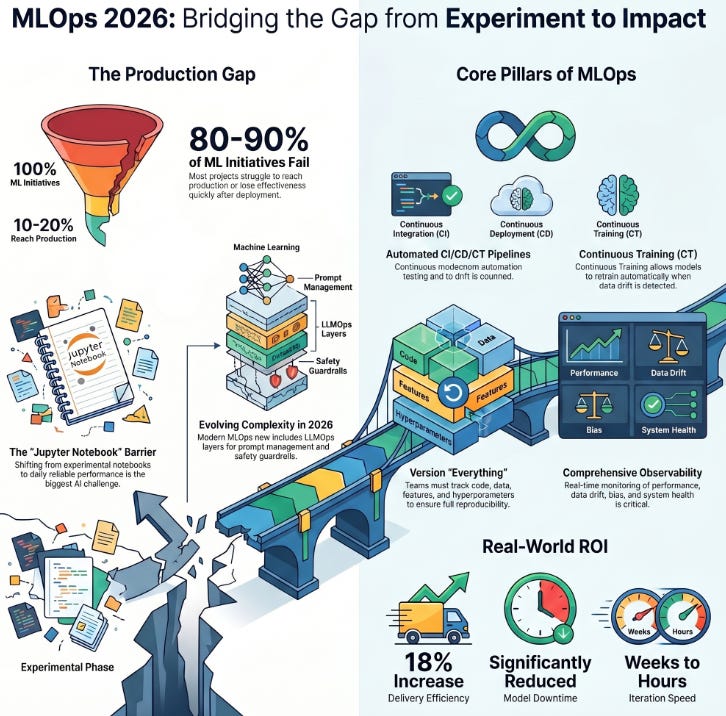
Let’s be honest. Many organizations pour weeks or months into developing sophisticated models, only to watch them underperform or fail entirely once deployed. Industry surveys suggest that up to 80-90% of ML initiatives struggle to reach production or lose effectiveness quickly due to changing data patterns, scalability issues, or lack of proper maintenance.
MLOps addresses this gap by merging the creativity of data science with the discipline of software engineering and operations. It’s the natural evolution of DevOps, tailored specifically for the unique complexities of machine learning where data, models, and code all evolve constantly.
In simple terms, MLOps is about creating repeatable, automated, and observable processes across the entire ML lifecycle: from data preparation and experimentation to deployment, monitoring, and continuous retraining. It fosters better collaboration between data scientists, ML engineers, DevOps teams, and business stakeholders. The result? Faster time-to-value, reduced risk, higher model reliability, and ultimately, AI systems that deliver consistent business impact.
With the explosion of large language models, generative AI, and agentic systems in 2026, MLOps has evolved into LLMOps in many organizations. Principles remain similar but now include additional layers around prompt management, safety guardrails, and evaluation of generative outputs. Whether you’re working with traditional ML or cutting-edge generative systems, strong MLOps practices are no longer optional they’re foundational.
Core Principles and Practices of MLOps
Let’s break down the key elements that make MLOps effective:
1. Versioning Everything
Traditional software versions code. In ML, we version code, data, features, hyperparameters, and models. This full reproducibility is crucial. Imagine needing to debug a model that suddenly started making biased predictions — without proper versioning, you’re essentially starting from scratch. Tools like DVC, lakeFS, or Git-integrated solutions make this manageable even with massive datasets.
2. Automated CI/CD/CT Pipelines
Continuous Integration, Continuous Delivery, and Continuous Training form the automation backbone. Pipelines automatically test data quality, validate model performance against benchmarks, run integration tests, and handle deployments. When new data arrives or drift is detected, models can retrain automatically. This dramatically reduces manual errors and accelerates iteration cycles from weeks to hours.
3. Robust Deployment Strategies
Deploying isn’t a one-time event. Smart teams implement blue-green deployments (seamless traffic switching), canary releases (gradual rollout to subsets of users), and shadow testing (running new models in parallel without affecting live traffic). Containerization using Docker combined with Kubernetes orchestration allows models to scale effortlessly while maintaining consistency across environments.
4. Comprehensive Monitoring and Observability
This is often where projects succeed or fail long-term. You need visibility into:
Model performance metrics (accuracy, precision, latency)
Data and concept drift detection
Resource utilization and costs
Fairness and bias indicators
System health and error rates
Advanced setups trigger alerts or automated retraining when thresholds are breached. In regulated sectors like healthcare or finance, this observability also supports auditability and compliance requirements.
5. Collaboration, Governance, and Culture
MLOps breaks down traditional silos. A centralized model registry serves as the single source of truth for approved models. Governance frameworks ensure ethical AI use, security, and regulatory adherence. Perhaps most importantly, it drives a cultural shift treating ML models as living products with clear owners, SLAs, and lifecycle management.
Challenges on the Journey
Implementing MLOps isn’t always smooth. Common hurdles include skill gaps across teams, tool fragmentation, high infrastructure costs, and resistance to changing established workflows. Starting small perhaps by adding experiment tracking and basic monitoring to your current projects often yields quick wins that build momentum for broader adoption.
Real-World Impact: A Quick Anecdote
I recently spoke with a lead ML engineer at a major logistics company. Their route optimization model performed excellently during development but started failing during peak festival seasons due to sudden shifts in traffic patterns and demand. Without proper drift monitoring, the business suffered delays and increased costs for weeks.
After adopting MLOps practices implementing automated pipelines, robust versioning, and real-time monitoring the system now detects changes early and retrains itself. Delivery efficiency improved by over 18%, and the team spends far less time firefighting. Stories like this highlight how MLOps transforms AI from an experimental curiosity into a dependable business asset.
Todays Paid edition
AI Workflow playbook
To learn more Practical implementation
Benefits and Future Outlook
When done well, MLOps delivers faster model deployment, improved reliability, better resource utilization, and stronger alignment with business objectives. Looking ahead to the rest of 2026 and beyond, we’ll see tighter integration with cloud platforms, more sophisticated automation for generative AI systems, and greater emphasis on responsible AI governance.
The organizations that master MLOps today will hold a significant competitive advantage as AI becomes even more embedded in core operations
Recommended Reads
The MLOps Playbook: 6 Best Practices for Success in 2026
Practical, actionable advice on quality control, automation strategies, and aligning ML initiatives with clear business objectives. Read More8 MLOps Best Practices You Should Implement in 2026
A comprehensive guide covering versioning, CI/CD automation, governance, monitoring for drift, and fostering cross-team collaboration. Read MoreMLOps in 2026 - The Definitive Guide
In-depth playbook exploring tools, cloud architectures, feature stores, and practical implementation strategies for production-grade systems. Read More
Trending in AI and Data Science
Let’s catch up on some of the latest happenings in the world of AI and Data Science
China’s Huawei reveals chip design breakthrough amid US sanctions
Huawei says chip progress can no longer depend only on smaller transistors, proposing a new design path to keep advancing amid US sanctions. The company frames the move as a long-term workaround for chip-making limits.
AMD plans to invest over $10 billion across Taiwan’s AI sector
AMD plans to invest more than $10 billion in Taiwan’s AI ecosystem to strengthen partnerships, expand semiconductor ties, and support next-generation AI development. The move deepens Taiwan’s role in AMD’s regional growth strategy.
Abu Dhabi launches intelligent surgical network
Abu Dhabi’s health regulator and Johnson & Johnson will build the world’s first emirate-wide intelligent surgical network, connecting hospitals with AI-driven analytics to improve precision, learning, and patient outcomes across surgery.
Trending AI Tool: MLflow

One of the most popular and battle-tested open-source platforms for end-to-end machine learning lifecycle management. It excels at experiment tracking, reproducible runs, model packaging, and features a powerful Model Registry for versioning and staging. Whether you’re a solo researcher or part of a large enterprise team, MLflow integrates smoothly with major frameworks and scales beautifully. It remains a top recommendation for teams serious about adopting MLOps practices.
Learn more.
Todays Paid edition
AI Workflow playbook
To learn more Practical implementation
Join the strong community of 670k+ readers
The 80-90% of ML initiatives that stall in production is the number every demo-day pitch forgets.
Your logistics case hitting 18% delivery efficiency only landed because someone owned the post-deploy drift, the unglamorous half of MLOps.
I write about that gap at theaifounder.substack.com: in your experience, does production failure trace more to data drift or to nobody owning the model after launch?