
Memory Mechanisms: How AI Agents Remember Your Preferences
Edition #258 | 04 Wednesday 2026

Hello!
Welcome to today’s edition of Business Analytics Review!
Today’s lands in my inbox – because it’s where the “magic” of AI stops feeling like magic and starts feeling genuinely useful.
We’ve all chatted with an AI assistant that nailed our question… only to forget everything the moment the conversation resets. Frustrating, right? Today we’re unpacking exactly How modern AI agents are learning to remember your preferences, habits, and history – and why OpenAI’s ecosystem is quietly betting big on one particular backend to make it happen.
Why Memory Is the Make-or-Break Feature for AI Agents
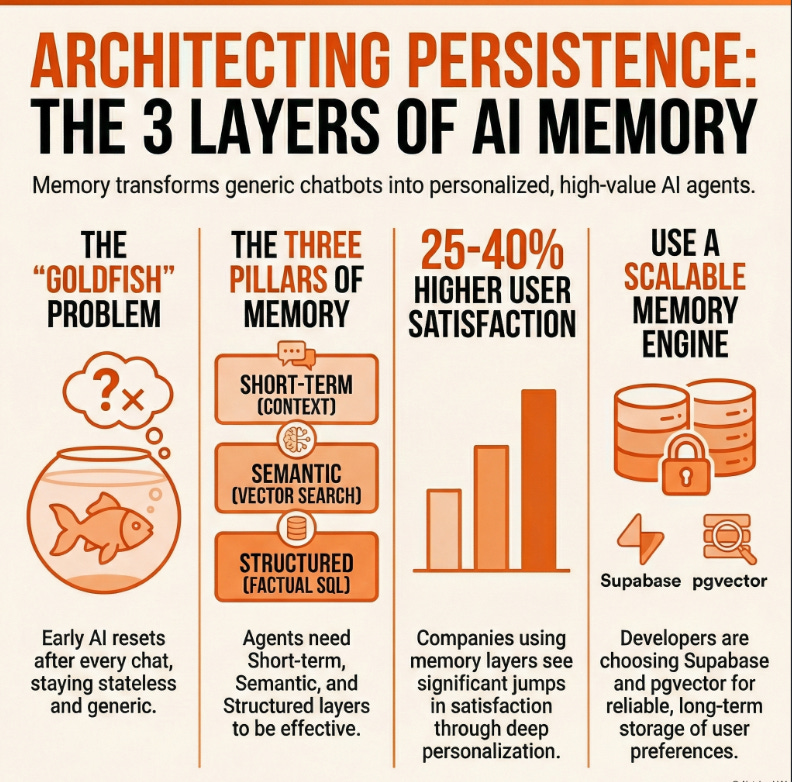
Think of early chatbots as goldfish – cute, but zero recall. Modern agents need three layers of memory to feel truly intelligent:
Short-term (in-context): The last dozen messages you just exchanged.
Semantic (vector-based): Fuzzy recall – “that productivity hack we discussed last month.”
Structured (factual): Hard data – your coffee order, budget limits, dietary restrictions, or quarterly goals.
Without these, agents stay stateless and generic. With them, they become personalized partners that get smarter every interaction.
OpenAI’s Quiet Bet on Supabase for Agent Memory
In April 2025, Supabase closed a $200 M Series D at a $2 B valuation. Among the standout angel investors? Kevin Weil, OpenAI’s Chief Product Officer.
That’s not just a nice name on a cap table – it’s a clear signal. OpenAI’s own models already integrate seamlessly with Supabase (direct embeddings support via OpenAI + pgvector). Developers building production agents are increasingly choosing Supabase’s open-source Postgres backend because it gives them:
Built-in pgvector for lightning-fast semantic search
Native Postgres Chat Memory that persists conversation history
A flexible “memories” schema where agents can create their own tables on the fly (yes, the LLM can literally design its own long-term storage)
In short: OpenAI’s leadership sees Supabase as the reliable, scalable memory engine that turns frontier models into agents users actually trust day after day.
Real-World Example: Your AI Shopping Sidekick That Never Forgets
Imagine an AI that helps with weekly groceries.
Week 1: You say “I’m trying to eat more plant-based and hate mushrooms.”
Week 4: It automatically filters out mushroom recipes, suggests oat-milk alternatives because it remembers you ran out last Tuesday, and even recalls you’re on a budget after that big vet bill in February.
That’s not prompt engineering – that’s structured + semantic memory working together in Supabase. The agent stores facts in SQL tables, embeddings in vectors, and recent chat in a simple history log. The result? Feels like it knows you.
Technical Sweet Spot Most Teams Are Hitting Right Now
Most successful agent deployments today combine:
In-session context (the model’s native window)
Vector retrieval (pgvector or similar) for relevant past memories
SQL ground truth for numbers, dates, preferences you never want hallucinated
Supabase makes all three trivial to wire up – and because it’s open-source and Postgres-native, you keep full data ownership and avoid expensive proprietary lock-in.
Business takeaway: Companies rolling out agentic workflows in customer support, sales, or internal ops are seeing 25-40 % higher user satisfaction once memory layers are added. Personalization isn’t a nice-to-have anymore – it’s table stakes.
Recommended Reads
Build a Personalized AI Assistant with Postgres
Discover how Supabase combines chat history, semantic vector search, and LLM-created SQL tables to give agents true long-term memory – complete with real examples of remembering coffee budgets and productivity tips.
Check it outMemory for AI Agents: A New Paradigm of Context Engineering
A thoughtful look at how memory is evolving from simple context stuffing into the foundation of agent identity and collaborative history. Check it outEngineering Memory for AI Agents: A Practical Guide
Step-by-step implementation advice for developers who want agents that actually learn user preferences instead of resetting every session.
Check it out
Trending in AI and Data Science
Let’s catch up on some of the latest happenings in the world of AI and Data Science
Bitcoin Miner MARA, Starwood Partner to Develop AI Data Centers
Bitcoin miner MARA Holdings partners with Starwood Capital to repurpose mining facilities into AI data centers, leveraging power infrastructure for high-demand AI computing amid surging needs.Qatar secures top-tier spot in global AI Adoption Index
Qatar ranks 16th in Cybernews’ AI Adoption Index with high consumer uptake of AI apps, supported by 99% internet penetration, National AI Strategy, and rapid organizational maturity growth to 39 score.Emirati education experts call for strong academic standards in age of AI
UAE experts urge treating AI as a study field in schools, emphasizing teacher guidance, critical thinking, ethical use, and new assessments to balance innovation with intellectual discipline amid approved AI platforms.
Trending AI Tool: Mem0

Mem0 is the self-improving, open-source memory layer purpose-built for AI agents and LLM apps. Drop it in with one line of code and your agent suddenly remembers user preferences across sessions, compresses history intelligently, cuts token costs by up to 80 %, and boosts accuracy by 26 % versus raw OpenAI memory. It’s already powering personalized experiences at scale for thousands of developers and just raised $24 M – definitely one to watch (and try) if you’re shipping agents in 2026.
Learn more.
Follow Us:
LinkedIn | X (formerly Twitter) | Facebook | Instagram
Please like this edition and put up your thoughts in the comments.
I landed on this exact same architecture 2 days ago, already have it implemented and working in my agent 🥳