
Generative Adversarial Networks (GANs) Explained
Edition #295 | 20 May 2026

Top LATAM talent, full US timezone overlap, at 42% less than US headcount cost.

100K+ vetted engineers, PMs, and designers. Compliance and contracts handled.
Every hire comes with benefits, HR check-ins, and ongoing support.
Hello!
Welcome to today’s edition of Business Analytics Review!
Today’s edition takes us into the heart of one of the most clever innovations in artificial intelligence: Generative Adversarial Networks, popularly known as GANs. Since their introduction in 2014, GANs have transformed how machines create new content, powering everything from stunning AI art to realistic synthetic datasets that solve real business problems.
If you’ve ever been amazed by photorealistic faces that don’t exist, or tools that turn rough sketches into polished images, you’ve witnessed GANs in action. Let’s unpack how they work, why they’re so powerful, and where they’re making the biggest impact.
The Brilliant Adversarial Game
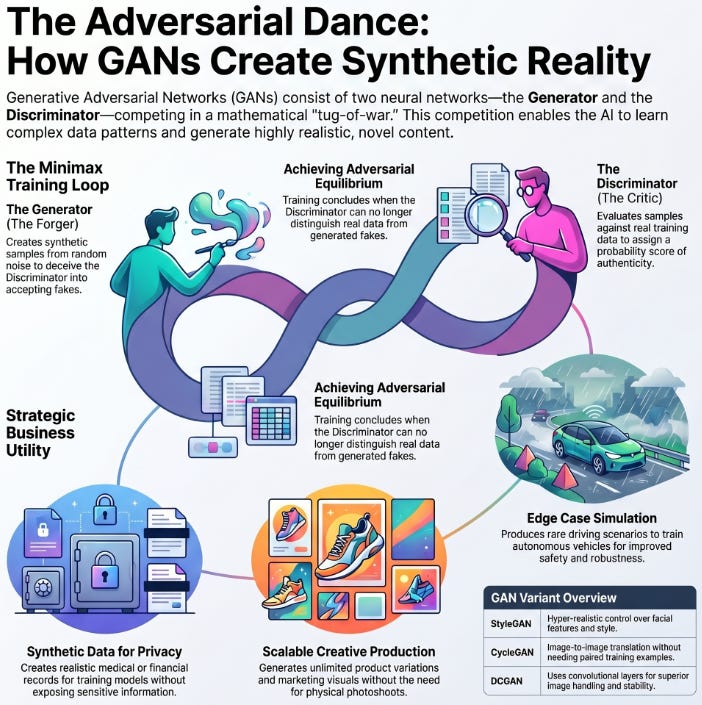
At its core, a GAN is a battle between two neural networks: the Generator and the Discriminator. Think of it as a master forger constantly trying to create perfect counterfeit artwork, while a seasoned art critic works tirelessly to spot the fakes. Each improves by learning from the other.
The Generator starts with random noise essentially meaningless data and tries to craft something realistic, like an image, audio clip, or even tabular business data. Its sole mission is deception: make outputs so convincing that they could pass as genuine.
The Discriminator, on the other hand, receives a mix of real samples from the training dataset and fake samples from the Generator. It learns to classify them correctly as “real” or “fake,” outputting a probability score.
This creates a minimax game a mathematical tug-of-war. The Generator tries to minimize the Discriminator’s ability to detect fakes, while the Discriminator maximizes its accuracy. Through backpropagation, both networks update their weights iteratively. Over time, the Generator becomes exceptionally skilled, and the Discriminator’s accuracy hovers around 50%, meaning it can barely distinguish real from generated data. At this equilibrium point, the Generator has effectively learned the underlying probability distribution of the real data.
Training a GAN is both elegant and notoriously challenging. Early stages produce obvious garbage outputs. As training progresses, common issues emerge mode collapse (where the Generator keeps producing the same few varieties), vanishing gradients, or training instability. That’s why researchers developed improved versions: DCGANs introduced convolutional layers for better image handling, while StyleGAN (from NVIDIA) brought unprecedented control over style and features, enabling those hyper-realistic celebrity faces we’ve all seen. CycleGANs even allow image-to-image translation without paired examples, such as turning horses into zebras or summer landscapes into winter scenes.
From Theory to Real-World Value
The training process typically involves thousands to millions of iterations. What makes GANs special is their ability to generate entirely new, never-before-seen samples that still feel authentic. Unlike traditional models that might simply memorize or interpolate, well-trained GANs create genuinely novel yet plausible data.
In business and industry, this capability is game-changing:
Image Synthesis & Creative Industries: Marketers generate unlimited product variations for e-commerce without costly photoshoots. Fashion brands prototype new designs, and filmmakers create realistic backgrounds or characters.
Synthetic Data Generation: Healthcare organizations use GANs to create synthetic medical images for rare conditions, helping train diagnostic models while protecting patient privacy. In finance, they generate synthetic transaction data to improve fraud detection systems without exposing sensitive information.
Data Augmentation & Autonomous Systems: Self-driving car companies simulate rare edge cases like unusual weather or accidents to make their AI more robust.
Other Emerging Applications: Super-resolution imaging (enhancing low-quality photos or medical scans), video prediction, drug molecule generation, and even personalized customer experiences.
I remember early demos where GAN-generated faces looked slightly “off” uncanny valley territory. Today, the quality is so high that distinguishing real from fake requires specialized tools. This rapid progress highlights both the opportunity and the responsibility deepfake concerns have pushed the community to develop better detection methods and ethical guidelines.
GANs beautifully demonstrate a key lesson in AI: competition can drive better results than solo optimization. By setting up this intelligent adversarial dance, we’ve unlocked creative potential that was hard to imagine just a decade ago.
As we move deeper into the generative AI era, understanding GANs provides crucial foundational knowledge. Whether you’re building models, evaluating vendor tools, or exploring new business use cases, grasping this architecture helps separate hype from genuine capability.
Recommended Reads
A Gentle Introduction to Generative Adversarial Networks
Clear, beginner-friendly breakdown with excellent intuition and code examples. Read MoreGenerative Adversarial Networks (GANs) – An End-to-End Introduction Comprehensive coverage of architecture, training dynamics, variants, and practical implementation. Read More
Generative Adversarial Networks (GANs): Architecture and Applications Business-focused overview with real-world use cases and deployment considerations. Read More
Trending in AI and Data Science
Let’s catch up on some of the latest happenings in the world of AI and Data Science
Abu Dhabi’s Phoenix partners with DC Max to unlock $8bln European AI Data Center opportunity
Abu Dhabi's Phoenix Group partnered with French developer DC Max to build its first European AI data center an 18MW facility in Lyon, France marking the launch of a platform targeting over 1GW capacity valued at ~$8 billion across Europe and the GCC. Construction starts July 2026, targeting completion in Q4 2027–Q1 2028.
AI Security Forum to highlight role of AI in shaping national security frameworks
The inaugural AI Security Forum debuts May 19–21 at Abu Dhabi's ISNR 2026, exploring how AI reshapes national security, cybersecurity, defense, and critical infrastructure protection for evolving threats.
Presight, Montenegro sign deal to advance AI-enabled national infrastructure
Abu Dhabi-based Presight AI and Montenegro signed an MoU to assess AI integration for Montenegro’s national infrastructure, aiming to modernize public services, boost digital transformation, and enhance efficiency across government systems.
Trending AI Tool: Flux.2 Pro

Flux.2 Pro by Black Forest Labs continues to impress with its outstanding photorealistic image generation, strong prompt adherence, and creative flexibility. It’s rapidly becoming a favorite for professional marketing visuals, design work, and synthetic data creation.
Learn more.
Follow Us:
LinkedIn | X (formerly Twitter) | Facebook | Instagram
Please like this edition and put up your thoughts in the comments.