
Freemium: Quantum Machine Learning: An Introduction
Edition #380 | 05 August 2026


AI Agents Masterclass (9th August 2026, Sunday)
All the PAID members of this newsletter can join this masterclass for FREE
Newsletter readers who wish to attend this Masterclass, are requested to subscribe to this newsletter. Readers of all plans can attend the Masterclass.
Hello!
Welcome to today’s edition of Business Analytics Review!
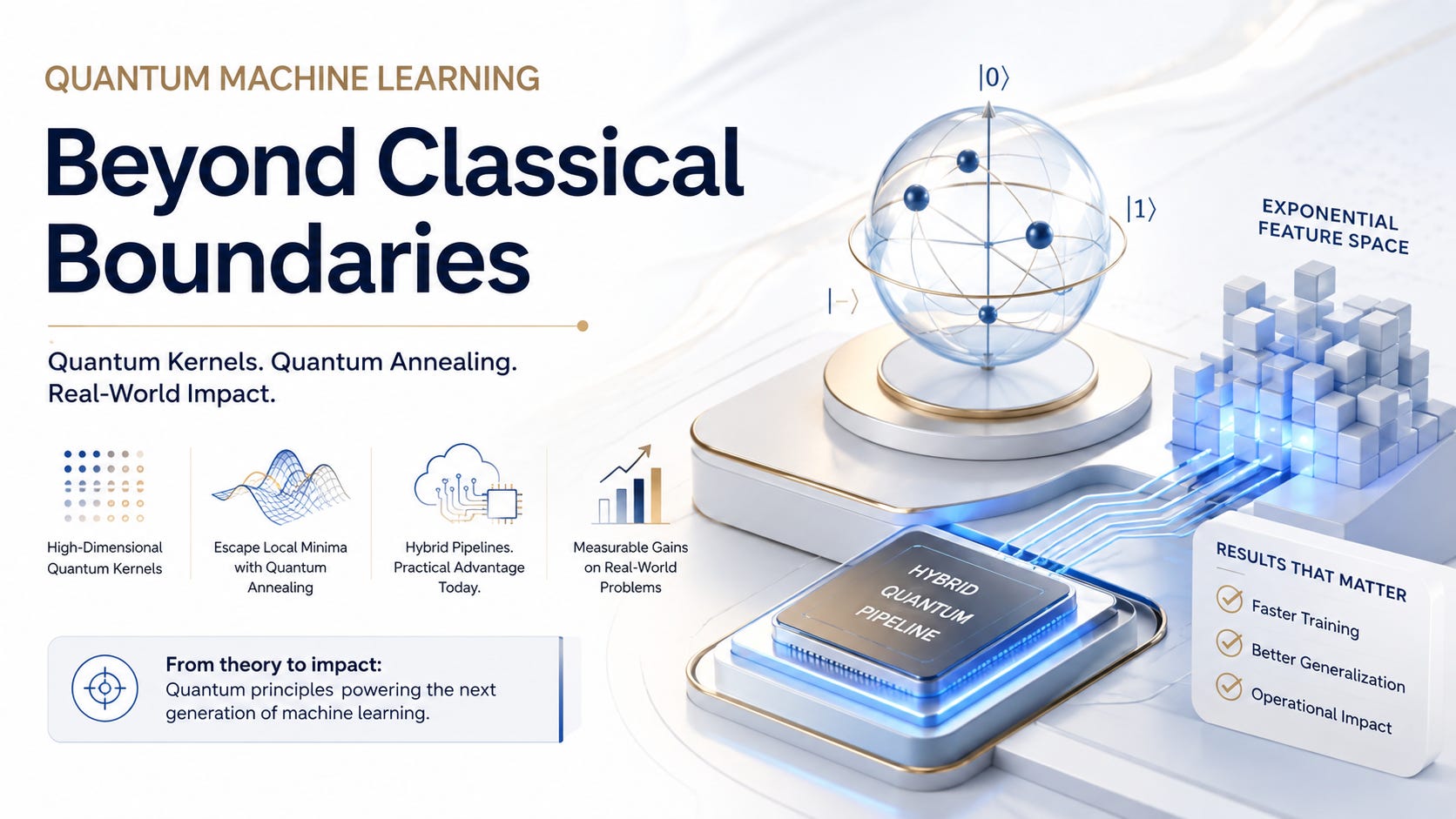
Classical machine learning keeps hitting the same wall: as feature spaces grow, kernel matrices and optimization landscapes explode in cost, while noisy industrial data traps gradient descent in shallow local minima. Quantum systems offer a different route. By encoding classical vectors into high-dimensional Hilbert spaces through superposition and entanglement, algorithms such as quantum support vector machines and quantum annealing can evaluate kernels or sample energy landscapes that classical hardware can only approximate at exponential expense. The paradox is sharp. Hardware remains noisy and limited, yet early hybrid pipelines already show measurable gains on classification and combinatorial tasks that once required days of classical compute.
The practical question is no longer whether quantum principles can touch machine learning. It is how operators extract usable advantage before fault-tolerant machines arrive, and which architectural choices turn theoretical speedups into operational wins.
The Core Problem: Why Status-Quo Approaches Fail
Standard support vector machines rely on the kernel trick to map data into a higher-dimensional space where linear separation becomes possible. On classical hardware the explicit feature map is never computed; only pairwise similarities appear in the kernel matrix. When the target feature space itself is exponential in the number of original dimensions, evaluating or even storing that matrix becomes prohibitive. Memory and floating-point operations scale with the square of the sample size times the cost of each kernel evaluation, quickly exhausting both RAM and GPU budgets for industrial-scale datasets in finance, chemistry, or sensor networks.
Gradient-based neural networks face a related trap. Loss landscapes for deep models contain vast plateaus and sharp local minima. Stochastic gradient descent samples only a narrow trajectory through that landscape. When the data distribution is multimodal or the model capacity is high, the optimizer settles into solutions that generalize poorly. Hyperparameter sweeps and ensemble methods mitigate the damage but multiply compute cost without changing the underlying geometry.
Quantum annealing and quantum kernel methods attack these friction points directly. Annealers exploit quantum tunneling to escape local minima that classical simulated annealing cannot cross efficiently. Quantum feature maps encode data into states whose inner products can be estimated with far fewer resources once the circuit is executed, potentially offering polynomial or exponential reductions in the effective complexity of kernel evaluation. The catch is noise, limited qubit counts, and the classical-quantum interface overhead. Without careful hybrid design, the theoretical advantage evaporates under decoherence and shot noise.
Key Takeaway: Classical kernels and optimizers fail when dimensionality or landscape complexity exceeds feasible classical resources; quantum embeddings and tunneling provide an alternative computational geometry, but only hybrid pipelines that isolate the quantum step deliver practical returns today.
The Paradigm Shift: What You Need to Know
Quantum Feature Maps and Kernel Estimation: Classical data points are loaded into quantum states via carefully designed circuits (angle encoding, amplitude encoding, or more expressive maps such as ZZFeatureMap). The overlap between two such states yields a kernel entry that lives in an exponentially large Hilbert space. On gate-based hardware the fidelity is estimated by circuit execution and measurement; the resulting matrix is handed to a classical SVM solver. This approach sidesteps explicit high-dimensional vectors and can capture correlations inaccessible to polynomial classical kernels of comparable cost.
Quantum Annealing for Optimization Subroutines: Many learning problems reduce to quadratic unconstrained binary optimization or Ising models. Quantum annealers (most prominently D-Wave systems) evolve a quantum system from a simple initial Hamiltonian toward the problem Hamiltonian. Quantum tunneling allows the system to traverse energy barriers that trap classical thermal annealers. In practice the annealer returns an ensemble of low-energy solutions rather than a single global minimum; that diversity often improves generalization when training data is scarce. Hybrid classical-quantum solvers further scale the approach to problems with hundreds of thousands of variables.
Hybrid Variational Circuits and Classical Outer Loops: Near-term devices cannot run deep fault-tolerant algorithms, so most production-oriented QML uses variational quantum circuits whose parameters are optimized by classical gradient or derivative-free methods. The quantum device evaluates expectation values or kernel matrices; the classical optimizer updates angles or selects the next annealing schedule. This division of labor keeps the quantum footprint small while still exploiting superposition for the hardest inner computations. Recent circuit architectures (butterfly layers, brick-wall designs) further reduce the number of circuit evaluations needed for gradient estimation, addressing the barren-plateau problem that previously rendered large variational models untrainable.
A Quick Story From the Field
A quantitative research group at a global bank needed a robust classifier for bond-trading signals drawn from high-dimensional market microstructure features. Classical kernel SVMs on the full feature set required several hours per training run and still underperformed on out-of-sample regimes characterized by sudden liquidity shocks. The team reformulated the kernel computation as a quantum feature map executed on IBM Heron hardware via Qiskit Runtime. Only a representative subsample of the training data (roughly 20 percent) was sent to the quantum device; the resulting kernel matrix was completed classically and fed to a standard dual SVM solver.
Training wall-clock time dropped from multi-hour classical runs to under forty minutes for the hybrid pipeline, while out-of-sample test scores improved by up to 34 percent relative to the pure classical baseline. The quantum kernel captured higher-order correlations among order-book imbalances that classical radial-basis kernels of practical width could not represent without excessive regularization. Subsequent inference ran entirely on classical hardware, so latency remained acceptable for production scoring. The experiment demonstrated that even noisy intermediate-scale quantum devices can supply useful feature geometry when the quantum step is narrowly scoped and the classical outer loop remains responsible for scale.
What This Means for You
Teams evaluating quantum machine learning should treat hardware access as a specialized accelerator rather than a wholesale replacement for classical stacks. Architecture reviews must quantify the classical-quantum data-transfer cost, the shot budget required for reliable kernel estimation, and the break-even point against GPU or TPU alternatives. Cost models should include both cloud quantum credits and the engineering time needed to map existing pipelines onto hybrid frameworks; latency budgets for real-time inference usually favor classical deployment of the final model.
On the execution side, start with small, well-understood classification or optimization subproblems that already strain classical kernels. Establish classical baselines first, then instrument quantum runs with identical data splits and metrics. Debugging focuses on circuit fidelity, measurement noise, and kernel-target alignment rather than traditional gradient diagnostics. Skill alignment means pairing domain ML engineers with quantum-circuit specialists or using mature libraries that abstract the quantum layer, so the broader team can iterate without mastering open-system dynamics.
AI & LLM Hacks: Practical Workflows for Quantum Machine Learning: An Introduction
Feature-Map Diagnosis Prompt: Feed an LLM a short description of your classical features and the target task, then ask: “Propose three quantum feature maps (angle, amplitude, and one custom entangling circuit) suitable for a binary classification problem with N continuous features. For each map list qubit count, circuit depth, and expected classical kernel complexity it aims to exceed. Output Qiskit or PennyLane pseudocode for the first map.” Iterate by supplying measured kernel-target alignment scores so the model refines the ansatz.
Hybrid Pipeline Scaffolding: Provide the LLM with a classical scikit-learn SVM pipeline and the instruction: “Rewrite this pipeline as a hybrid quantum-classical workflow. Keep data loading and final prediction classical. Insert a quantum kernel estimation step using FidelityQuantumKernel. Add comments that flag every point where shot noise or decoherence can degrade the kernel matrix, and suggest mitigation (error mitigation, zero-noise extrapolation, or classical post-processing).” The resulting skeleton accelerates first experiments on simulators before hardware runs.
Annealing Formulation Assistant: Describe a constrained combinatorial objective (portfolio selection, scheduling, or clustering) and prompt: “Convert the following objective and constraints into a QUBO suitable for D-Wave Ocean or a hybrid CQM solver. Show the binary variable encoding, the quadratic terms, and the penalty coefficients needed to enforce each constraint. Then generate a minimal Python snippet that builds the BQM and samples it.” Use the output as a starting point, then validate energy values against a classical solver on toy instances.
Recommended Reads
Guide to Quantum ML for Data Scientists
This practical overview walks through the core ideas of quantum feature maps, quantum support vector machines, and the hybrid workflow that feeds quantum kernels into classical solvers. Readers gain concrete intuition for when a quantum kernel may outperform classical alternatives and how to prototype the pipeline on available simulators and cloud hardware. Read MoreQuantum Machine Learning Tutorial (Hands-on)
Designed for practitioners already comfortable with classical ML, this tutorial covers foundational quantum computing concepts, quantum kernel methods, variational classifiers, and code examples that run end-to-end on MNIST and other standard datasets. The emphasis on learning theory and computational complexity helps teams set realistic expectations for near-term advantage. Read MoreWhat is Quantum Machine Learning (QML)?
A clear, up-to-date primer that situates QSVM, quantum annealing, and variational methods within the broader NISQ landscape. It includes concrete workflow descriptions (encoding, sampling, classical post-processing) and honest assessment of domains where quantum advantage is most plausible today. Read More
Trending in AI and Data Science
Catch up on key market movements and technical breakthroughs:
Volta Secures $10 Billion AI Infrastructure Deal, Reaches $2.4 Billion ValuationVolta Infra, a seven-month-old AI infrastructure startup, reached a $2.4 billion valuation after securing a $10 billion European AI cloud-computing contract and launching a $5 billion AI infrastructure program, accelerating large-scale AI infrastructure expansion.
Amazon Joins the $3 Trillion Club as AI Optimism Drives Record Rally
Amazon surpassed a $3 trillion market valuation after strong earnings and accelerating AI-driven cloud demand boosted investor confidence. Robust AWS growth and increased AI infrastructure spending reinforced Wall Street’s optimism about Amazon’s long-term AI strategy.
Alibaba Unveils Its Most Powerful AI Model Yet to Challenge Global Leaders
Alibaba introduced Qwen3.8-Max, its largest and most capable AI model to date, featuring 2.4 trillion parameters and open-weight availability. The model intensifies competition with OpenAI, Anthropic, and Moonshot while highlighting China’s rapid progress in frontier AI development.
Tool of the day: PennyLane

PennyLane is an open-source Python framework purpose-built for quantum machine learning and differentiable quantum programming. It treats quantum circuits as trainable functions that integrate seamlessly with PyTorch, JAX and NumPy, allowing operators to optimize hybrid models with the same automatic-differentiation tools used for classical networks. By abstracting hardware backends (including IBM, IonQ and simulators) behind a unified interface, it lets teams prototype quantum kernels and variational classifiers on laptops and then scale the identical code to cloud quantum processors, dramatically shortening the path from idea to measurable experiment.
Learn more.

AI Agents Masterclass (9th August 2026, Sunday)
All the PAID members of this newsletter can join this masterclass for FREE
Newsletter readers who wish to attend this Masterclass, are requested to subscribe to this newsletter. Readers of all plans can attend the Masterclass