
Freemium: Beyond Transformers: The Quest for Next-Generation Foundation Models
Edition #332 | 01 July 2026

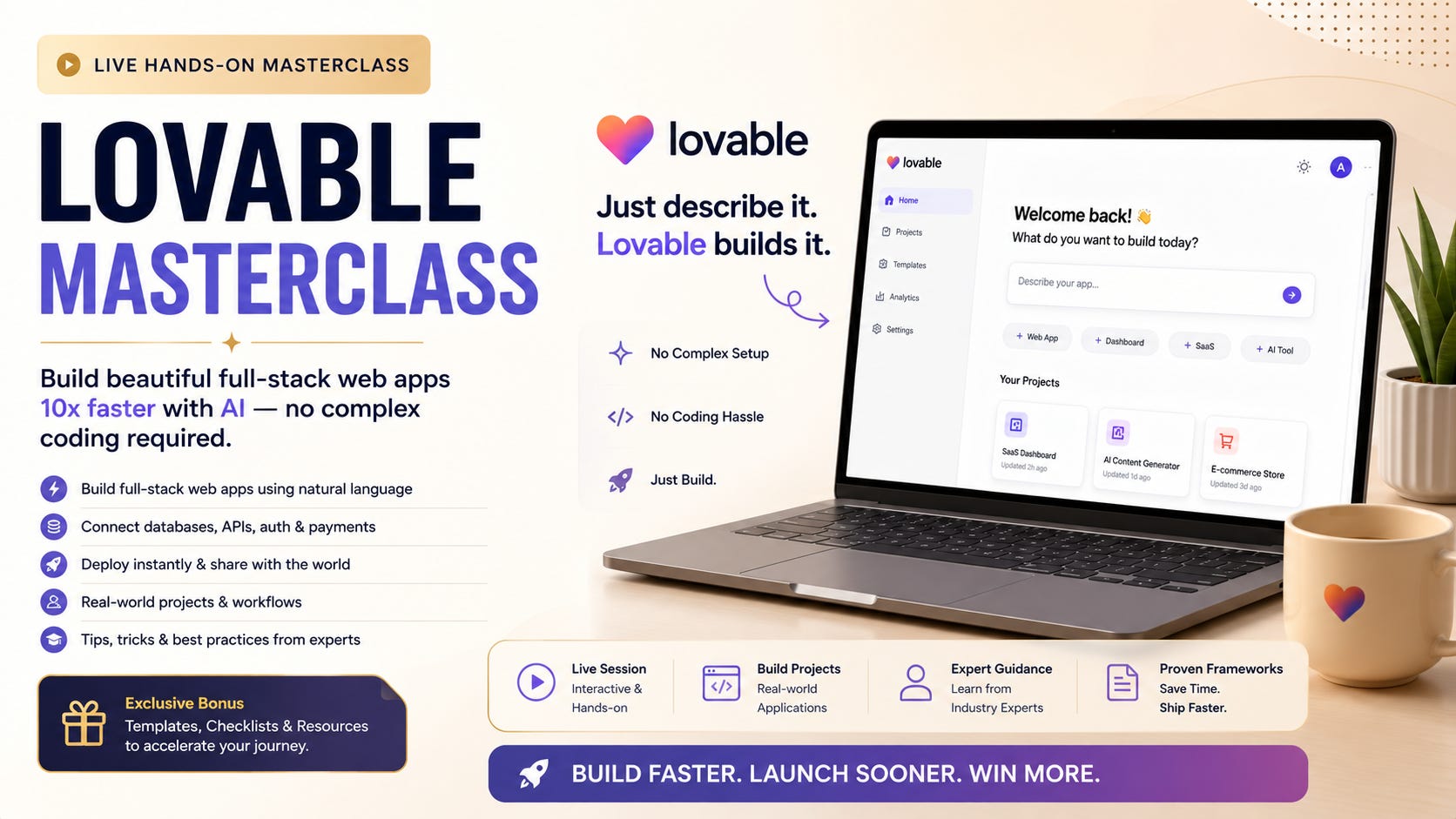
Fill this form to enroll for the Lovable Masterclass
https://tally.so/r/GxgyOQ
Paid Readers of this newsletter (yearly plan members) get this Masterclass for FREE
Subscribe to our yearly plan & receive this Masterclass for FREE
Hello!
Welcome to today’s edition of Business Analytics Review!
I’m glad you’re joining me as we dive into one of the most exciting frontiers in AI right now. If you’ve been following the rapid evolution of foundation models, you know that Transformers have been the undisputed kings for years. But cracks are showing in the foundation, and a new generation of architectures is emerging to address them.
Today’s topic: Beyond Transformers: The Quest for Next-Generation Foundation Models, with a focused look at physics-inspired models like Mamba and the real limitations of current Transformers. I’ll walk you through why this matters for business analytics, the technical nuances, industry implications, and what’s on the horizon. Let’s make this practical and insightful because understanding these shifts can give your organization a real edge in efficiency, scalability, and innovation.
The Transformer Era: Revolutionary, But Not Perfect
When the Transformer architecture burst onto the scene in 2017 with “Attention Is All You Need,” it changed everything. Self-attention allowed models to weigh the importance of different parts of a sequence simultaneously, enabling parallel training and capturing long-range dependencies far better than recurrent networks. This powered GPTs, BERT, and countless foundation models that now drive everything from chatbots to code assistants and multimodal analytics tools.
In business contexts, Transformers excel at tasks like natural language processing for customer sentiment analysis, document summarization, predictive maintenance from time-series logs, and even generating insights from vast datasets. Their strength lies in flexibility and expressiveness every token can theoretically attend to every other token.
But as models scale and real-world demands grow (think hour-long video analysis, massive financial transaction histories, or enterprise knowledge bases with millions of tokens), limitations become painfully apparent.
Key Limitations of Transformers:
Quadratic Computational Complexity: Self-attention scales as O(n²) with sequence length n. Training and inference get exponentially more expensive for long contexts. Memory usage balloons, making deployment on anything but high-end hardware challenging. For businesses dealing with long documents, extended conversations, or high-frequency sensor data, this translates to higher costs and slower responses.
Context Window Constraints and Diminishing Returns: Even with clever engineering (like sparse attention or efficient variants), extending context windows has limits. Performance gains plateau, and models can struggle with “needle in a haystack” retrieval in very long sequences. Anecdotally, users notice hallucinations or forgotten details in extended interactions.
Compositionality and Reasoning Challenges: Recent theoretical work highlights deeper issues. Transformers can struggle with function composition (e.g., multi-hop reasoning like identifying a grandparent in a family tree) for large domains, contributing to hallucinations. They’re great at pattern matching but less inherently suited for certain structured, compositional tasks without massive scale or additional techniques.
Resource Intensity and Environmental Impact: Training and running large Transformers demand significant compute, leading to high carbon footprints and accessibility barriers for smaller teams or edge deployments. In business analytics, this means not everyone can afford cutting-edge capabilities.
Other Nuances: Sensitivity to data quality, black-box interpretability issues, and challenges with rare events or highly sensitive tasks where small input changes drastically affect outputs. Edge cases in production like real-time analytics on streaming data expose brittleness.
These aren’t just academic gripes. For a business analyst processing quarterly reports spanning thousands of pages or an operations team monitoring IoT data over weeks, these limitations hit the bottom line: slower insights, higher costs, and missed opportunities.
I remember chatting with a colleague at a fintech firm who described spending a fortune on GPU hours just to handle longer context for fraud detection sequences. They were hitting walls until alternatives started showing promise.
Enter Physics-Inspired Models: The Rise of Mamba and State Space Models (SSMs)
Here’s where it gets exciting. Researchers are drawing inspiration from physics, control theory, and continuous dynamical systems to create more efficient sequence models. Mamba, introduced in late 2023 by Albert Gu and Tri Dao, is a standout. It’s built on Structured State Space Models (SSMs) a framework rooted in classical control theory and linear dynamical systems.
Think of it this way: Instead of every token talking to every other (like a crowded party where everyone shouts across the room), Mamba maintains a compact “state” that evolves over time, selectively remembering or forgetting information based on the current context. It’s like a smart filter or a physical system’s state transitioning smoothly.
How Mamba Works (Intuitively):
Selective State Space: The model dynamically adjusts what to keep in its hidden state. Irrelevant info is discarded efficiently.
Linear-Time Scaling: Inference and training scale linearly with sequence length O(n) instead of O(n²). This enables handling million-token contexts with far less memory and faster speeds (up to 5x faster inference than comparable Transformers in some benchmarks).
Hardware-Aware Design: Optimizations like parallel scans make it practical on real GPUs.
Mamba (and its evolutions like Mamba-2 and Mamba-3) has shown impressive results: matching or outperforming Transformers of similar size on language modeling, genomics, audio, and more, while excelling at long sequences. Hybrids combining Mamba with attention layers are also emerging, blending the best of both worlds.
Why Physics-Inspired? Broader trends include Neural ODEs, Hamiltonian networks, and energy-based models, which model data as evolving physical systems. This brings inductive biases from the real world smooth dynamics, conservation laws that can lead to better generalization, especially in scientific or time-series heavy business analytics (e.g., supply chain forecasting, financial modeling).
Industry Implications and Examples:
Efficiency Gains: Lower inference costs mean you can deploy powerful models on-premises or at the edge for real-time analytics without breaking the bank. Imagine fraud detection on streaming transactions without latency spikes.
Long-Context Applications: Better handling of entire codebases, long legal documents, or patient histories in healthcare analytics.
Sustainability: Reduced compute needs align with corporate ESG goals.
Democratization: Smaller teams can experiment with capable models. Companies like Mistral, Cartesia, and IBM are already exploring Mamba-based or hybrid solutions.
That said, Mamba isn’t a silver bullet. It may lag in some in-context learning or copying tasks compared to Transformers, and scaling to the absolute largest models is still maturing. Hybrids often win in practice. The quest continues expect more innovations in 2026 and beyond.
From a business perspective, this shift encourages thinking beyond “bigger is better.” Focus on efficient architectures tailored to your data modalities. Pilot Mamba-based tools for long-sequence tasks and measure ROI in latency, cost, and insight quality. Anecdotes from early adopters suggest 2-5x speedups in specific workflows, which compounds dramatically at scale.
There are nuances: Training dynamics differ, so fine-tuning strategies evolve. Interpretability might improve with more structured state representations. And for multimodal foundation models (text + vision + time-series), physics-inspired approaches could unlock new capabilities in business intelligence dashboards or predictive simulations.
Edge cases to watch: Very short sequences might still favor classic Transformers; highly irregular data could require careful adaptation. Regulatory and ethical considerations remain efficient models don’t automatically solve bias or hallucination issues.
Overall, we’re in a transitional phase. Transformers won’t disappear overnight, but the quest for next-gen models is accelerating innovation across the board.
Recommended Reads
Mamba Explained
A clear, in-depth breakdown of how State Space Models challenge Transformers, with strong intuition on the mechanics and performance. Read MoreA Visual Guide to Mamba and State Space Models
Packed with illustrations that make the concepts intuitive, perfect for building a mental model of why selective SSMs work so well for sequences. Read MoreMamba vs Transformers: Efficiency, Scale, and the Future of AI
Explores practical trade-offs, scaling implications, and business-relevant comparisons between the architectures. Read More
Trending in AI and Data Science
Let’s catch up on some of the latest happenings in the world of AI and Data Science
Anthropic launches Claude Sonnet 5 as a cheaper way to run agents
Anthropic released Claude Sonnet 5, positioning it as a more capable agentic model optimized for tool use, coding, and autonomous workflows. The release focuses on bringing stronger AI-agent performance at lower cost compared with larger models.
US to lift export controls on Anthropic's Fable AI model on Tuesday, source says
The U.S. government is expected to ease restrictions on Anthropic’s Fable 5 model after earlier limiting access over national security concerns. The move highlights increasing government involvement in frontier AI deployment.
OpenAI limits GPT-5.6 rollout after government request, says restrictions shouldn’t be the norm
OpenAI confirmed a limited GPT-5.6 rollout to trusted partners following government pressure. The story highlights a shift toward pre-release oversight for frontier models.
Trending AI Tool: Together AI
Together AI and collaborators provide optimized platforms and open-source support for running Mamba-3 and hybrid SSM models efficiently. These tools emphasize fast inference for long contexts, making them ideal for business analytics teams prototyping next-gen sequence models on production data think rapid experimentation with lower costs than full Transformer stacks. Great for developers and analysts exploring efficient foundation models.
Learn more.

Fill this form to enroll for the Lovable Masterclass
https://tally.so/r/GxgyOQ
Paid Readers of this newsletter (yearly plan members) get this Masterclass for FREE
Subscribe to our yearly plan & receive this Masterclass for FREE