
Data Wrangling Techniques
Edition #301 | 03 June 2026

How Will You Drive Resilience in the Face of AI?

AI killed traditional cybersecurity. AI-powered attacks happen in 27 seconds. Recovery takes 27 days - or weeks. Join us at Forward to understand today’s threats and discover state of the art solutions for Agentic Cyber Resilience. Hear from celebrity John Cena and Jason Clinton, CISO at Anthropic.
Hello!
Welcome to today’s edition of Business Analytics Review!
Today, we’re rolling up our sleeves and getting into something every data professional eventually bumps into: Data Wrangling. Whether you’ve been building machine learning pipelines for years or just started your analytics journey, you already know that the quality of your insights is only as good as the quality of your data. And trust me, raw data is almost never “good.”
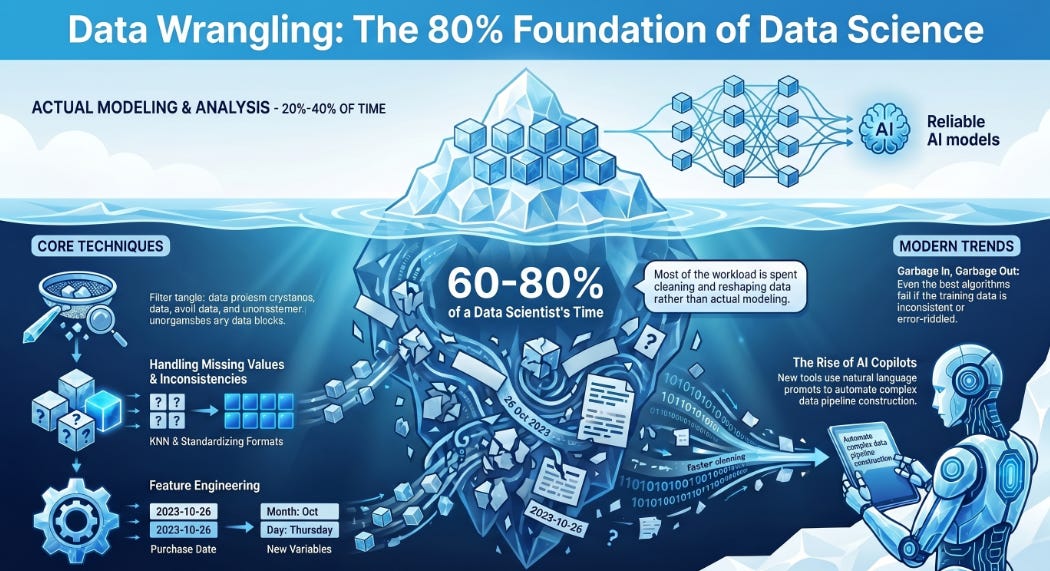
So let’s talk about what it really takes to tame that wild, messy data — and why this underrated skill might just be the most important one in your toolkit right now.
Why Data Wrangling Deserves More Love
Here’s a number that never stops surprising people: data scientists spend roughly 60 to 80 percent of their time just preparing data — cleaning it, reshaping it, handling missing values, and getting it into a format that a model can actually learn from. That’s not a typo. Only the remaining slice goes toward the actual modeling work.
Think about it this way. Imagine hiring a brilliant chef to cook a five-star meal, but then handing them rotten ingredients. It doesn’t matter how talented they are — the dish is going to disappoint. The same principle applies to AI and ML models. Even the most sophisticated algorithm will produce unreliable results if the training data is inconsistent, incomplete, or riddled with errors. Garbage in, garbage out — as the saying goes.
Data wrangling — sometimes called data munging — is the process of transforming raw, often chaotic data into a clean, structured, and analysis-ready format. It isn’t glamorous work, but it is absolutely foundational.
The Core Techniques You Should Know
Let’s break down what modern data wrangling actually involves, so you can appreciate the depth of what’s happening behind the scenes (and in your Jupyter notebooks).
Handling Missing Values
Every real-world dataset has them. Missing values can arise from sensor failures, manual entry errors, or simply because that information was never captured. The approach depends on context: sometimes you drop incomplete rows, other times you fill in the gaps using statistical methods like the mean or median. For time-series data, forward-fill or backward-fill techniques work elegantly. For more complex cases, models like K-Nearest Neighbours (KNN) imputation are being used to estimate what those values likely should have been.
Removing Duplicates and Fixing Inconsistencies
When data is merged from multiple sources — say, a CRM, a sales database, and a third-party API — duplicate entries are almost inevitable. Left unaddressed, they skew your results and inflate your metrics. Inconsistent formatting is equally sneaky. “New York”, “new york”, “N.Y.”, and “NY” are all the same city, but a machine will treat them as four distinct entities unless you standardize first.
Feature Engineering and Transformation
Raw data often needs to be reshaped before a model can extract value from it. This includes encoding categorical variables (turning “Yes/No” into 1/0), normalizing numerical ranges, and creating new derived features from existing columns. For example, from a “date of purchase” column, you might extract the day of week or the month — features that can reveal seasonal buying patterns.
Dealing with Outliers
An outlier is a data point that sits far outside the normal range. It might be a genuine anomaly worth investigating, or it might be a data entry error. ML-driven anomaly detection is becoming increasingly common here — models can now scan datasets and flag suspicious values automatically, saving analysts hours of manual inspection.
Automating the Pipeline
This is where things get exciting. Modern data teams are no longer doing these steps one by one in isolation. Tools like Apache Airflow and Luigi are used to orchestrate automated wrangling workflows. Libraries like Dask and PySpark allow teams to run these transformations in parallel across massive datasets that would otherwise crash a single machine.
How AI Is Changing the Wrangling Game
We’re at a fascinating inflection point. For years, data wrangling was almost entirely manual — a painstaking, human-driven process. That’s beginning to change.
AI-powered tools are now capable of scanning datasets in real time, spotting patterns and data quality issues automatically, and even recommending transformations based on historical usage. Think of it as having an intelligent assistant who has seen thousands of datasets before yours and can instantly suggest: “Hey, this column looks like it has a unit inconsistency — want me to fix it?”
Platforms like Matillion now offer AI Copilot features that let users build entire data pipelines using plain natural language prompts. You describe what you want to do with your data, and the tool does the heavy lifting. It’s not magic — but it’s getting close.
Still, it’s worth noting something important: data wrangling is not yet fully automated. Human judgment remains critical, especially when domain expertise is needed to validate transformations or make decisions about ambiguous data. The best teams today combine smart tooling with skilled, thoughtful professionals.
Recommended Reading
We’ve curated three excellent reads this week to help you go deeper on the topic. Whether you’re looking for a conceptual grounding or a hands-on technical guide, there’s something here for everyone.
The Art of Data Wrangling in 2026: Techniques and Trends
A comprehensive, forward-looking guide that covers how automation, AI, and real-time processing are reshaping data wrangling workflows for modern analytics teams. Read More
Data Wrangling 2025 Mastery: Conquer Messy Data for Unbeatable Insights
A hands-on deep dive into advanced wrangling techniques — including automated pipelines, handling imbalanced datasets, and ML-driven anomaly detection — with practical examples throughout. Read More
Foundations of Data Wrangling for Aspiring Data Scientists
A beginner-to-intermediate walkthrough of essential data cleaning and preparation steps, written accessibly for data scientists who want to build strong foundational habits early. Read More
Trending in AI and Data Science
Let’s catch up on some of the latest happenings in the world of AI and Data Science
Anthropic scales Claude Mythos to critical infrastructure in 15+ countries
Anthropic is expanding Project Glasswing to roughly 200 organizations across more than 15 countries, granting access to Claude Mythos for identifying critical software vulnerabilities and strengthening cybersecurity protections for essential infrastructure.
Trump signs narrower executive order on AI oversight after industry objections
President Donald Trump signed an executive order encouraging AI companies to voluntarily submit advanced models for government review before release, balancing national security concerns with industry demands for regulatory flexibility.
Nvidia’s new PC chips are CEO Huang’s bid to win at every layer of AI stack
Nvidia unveiled RTX Spark AI PC chips, extending its reach beyond data centers into personal computing. CEO Jensen Huang aims to control more of the AI ecosystem through integrated hardware platforms.
Trending AI Tool: Julius AI

If you’ve ever wished you had a data analyst sitting right next to you, Julius AI comes close. It’s a no-code AI-powered data analysis platform that lets you upload your datasets — CSVs, Excel files, Google Sheets, even PDFs — and then simply ask questions about your data in plain English. No SQL. No Python. No frustration.
Behind the scenes, Julius writes and runs the code itself, cleans your data as needed, and delivers insights through charts, summaries, and visual reports. What makes it particularly impressive is its contextual memory within sessions — it remembers what you asked before and can even suggest smart follow-up questions you might not have thought of. It’s been gaining traction fast among business analysts, marketers, researchers, and anyone who works with data but doesn’t want to be held back by technical barriers.
For those of you exploring ways to make your data wrangling and analysis workflows faster and more accessible, Julius AI is absolutely worth a look. Explore here
Join our premium Alpha Intelligence Elite Program.
You will get access to private skool community of like minded AI Folks.
Why joining this community matters ?
- Private AI Intelligence Briefings
- Weekly “What Actually Matters in AI” Analysis
- High-Signal Network of Founders, Entrepreneurs, Consultants, AI professionals etc.
- Members-Only Discussions
Cost of this skool community for Regular Members - $50 month | $580 yearly
Cost for Alpha Intelligence Elite Member - FREE